 Jacques Becker’s final film is an intensely focused drama about a seemingly impossible prison escape, based on real events.
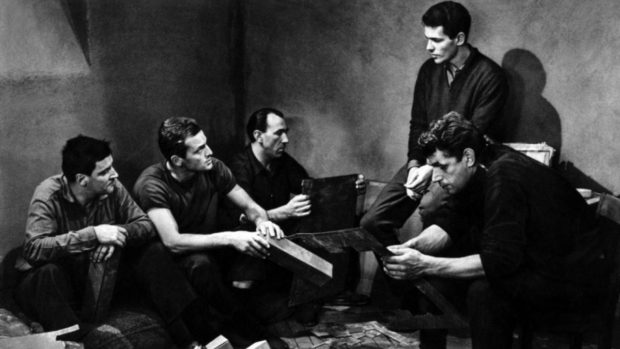
Four men sharing a cell in a Paris prison are planning a daring escape, when a fifth man (played by Marc Michel), in jail for attempted murder, is introduced into the cell. After learning to trust him, they draw him into their plan, which involves digging a hole and escaping through the sewer system below the prison. From 1960, the film is Le Trou, or, “The Hole.”
Veteran filmmaker Jacques Becker was mortally ill when he directed this, his last film; and he died just two weeks after it was completed. José Giovanni, an ex-convict himself, had written a novel in 1957 called “The Break,” based on real events from ten years earlier. Becker read the book, and got Giovanni to collaborate on the script. Becker’s career included films in almost every genre: romance, comedy, period or costume drama, crime, and fantasy. It seems fitting that his last film is completely free from the desire to appeal to the mass market. It’s an intensely focused portrait of desperate effort—something close to what some would call “pure cinema.”
This is a movie rigorous in style and full of suspense. Becker focuses on the methods of escape—the digging of the hole in the cell, for instance, is shot in something close to real time, so that the viewer experiences the minute-by-minute process. And that’s just the beginning. Once the inmates get below, they still have to explore the huge underground cellar, find a way into the sewers, and then dig a tunnel around a concrete barrier. It will take many days to accomplish all this, and in the meantime they need to cook up a way to fool the guards into thinking everyone is still in the cell.
The other aspect that emerges from Becker’s approach is the sense of cooperation and camaraderie, mostly nonverbal, that develops between the men. He used non-professional actors to play the inmates, and got strong, expressive performances from all of them. (The leader of the group is played by Jean Keraudy, one of the participants in the actual incident the film is based on—and his performance is excellent.)
Le Trou has no music, nothing to distract us from the concentrated, persistent effort of the men to complete their plan. It’s a very physical film, ingenious in its use of long takes that increase the tension, and it’s also very disciplined in the way it lets the actors’ faces and body movements communicate feelings. Considered strictly as a suspense film, it’s utterly gripping. But it also explores deeper issues of loyalty, integrity, and doubt, issues that come together in the film’s unforgettable ending. A superb little film that deserves to be better known, Le Trou is available on DVD.

A splendid adaptation of Balzac’s great novel about a young poet becoming embroiled in the petty world of Paris journalism in the 1820s. Lost...
John Carpenter’s first feature, a low budget science fiction comedy, drily exposes the complete inadequacy of human beings when measured against the cosmos. John...
Fritz Lang’s 1931 crime picture remains one of the greatest depictions of social rot ever put on film. Once in awhile I get asked...